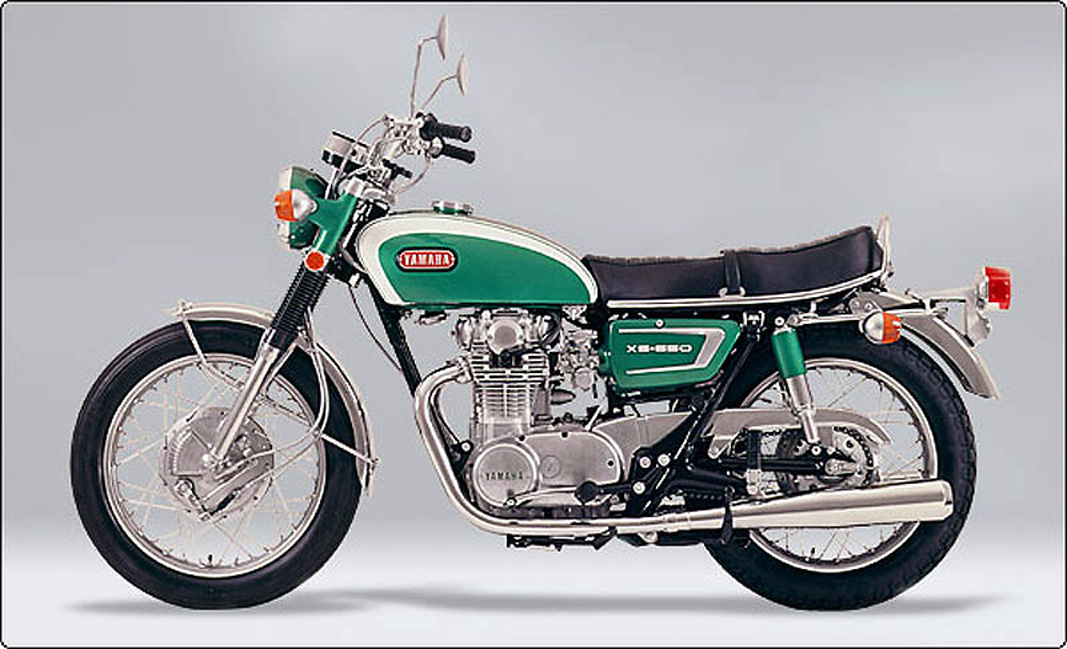
YAMAHA XS-650 (XS1)
Breaking With Tradition To Extend An Older One, Yamaha Comes Up With A Well-Disguised Racing Engine In A Sporting Big Bore Roadster.
Original article appeared in Cycle World
magazine Road Test Annual, 1970
 YAMAHA'S NEW BIG BORE
will be likely to cause confusion to innocent bystanders.
From a distance it resembles several other machines that follow the almost
classic 650-cc or 750-cc vertical Twin pattern.
YAMAHA'S NEW BIG BORE
will be likely to cause confusion to innocent bystanders.
From a distance it resembles several other machines that follow the almost
classic 650-cc or 750-cc vertical Twin pattern.
It
may seem strange that Yamaha-breaking with tradition to build its first four-stroke
machine-would follow a path already beaten. Starting from scratch they
could have opted to build a three- or four-cylinder super bike. But the
situation in both the Japanese and
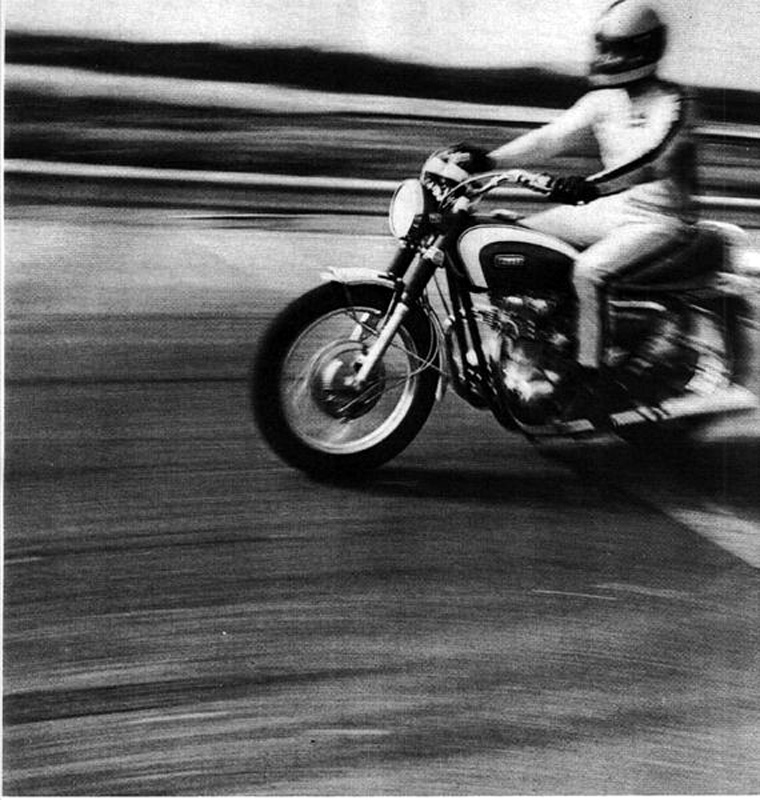
But there are differences that are quite Japanese. Flywheel effect is lighter, and the engine picks up revs quite rapidly when the throttle is blipped. The five-speed gearbox shifts on the left. The XS-650 is delivered in a tractable state of tune, and doesn't really need the five ratios. But the gearbox, the single overhead camshaft, and the overall construction of the engine beg the race tuner's hand. The machine is robust, laid out for rapid access to its internals, and ready to be stretched.
It
may seem rather rude to call the engine layout of the XS-650
"conventional," for the machine is the most sophisticated 650-cc Twin
commercially produced. But
conventional it is, in Japanese terms. And
this normalcy is actually a desirable attribute. The
practice is already proven.
For
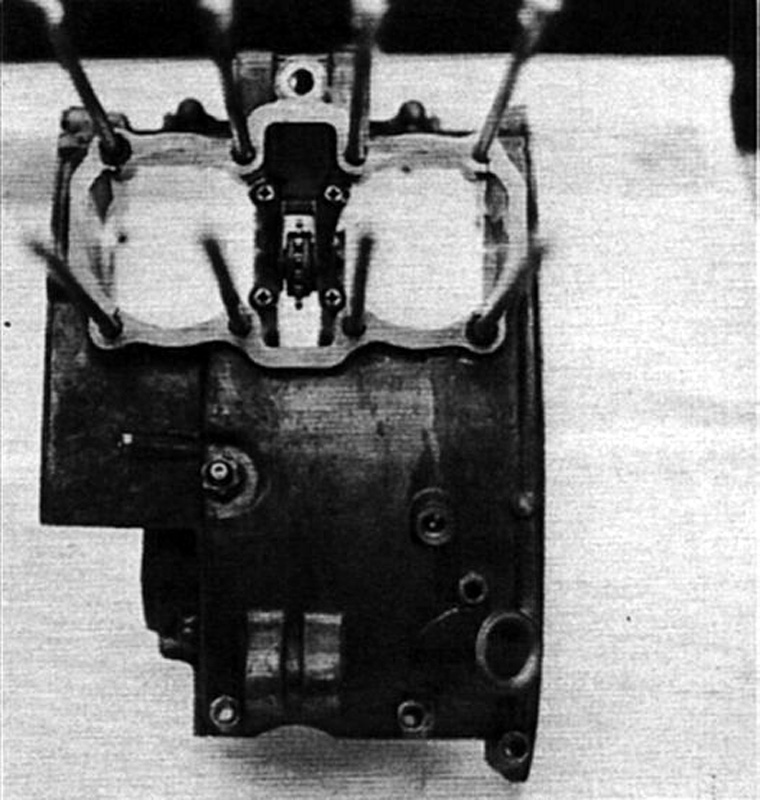
example, the crankcases split horizontally, offering the advantages of oil
tightness through the elimination of vertical joints and one-step access to both
the lower end and the gearbox. The
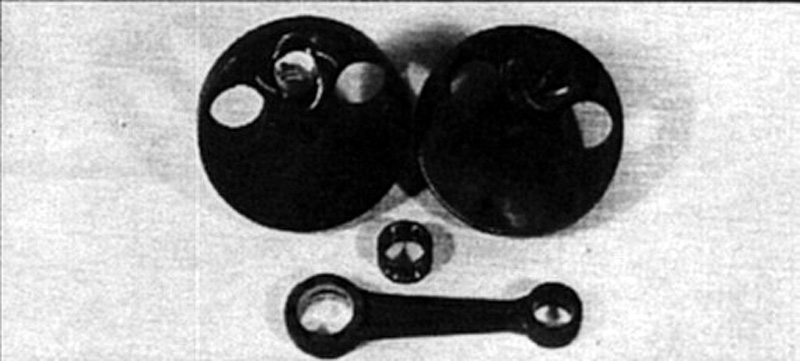
650's four-main-bearing crankshaft, made up of four separate flywheels, recalls
the practice established by Honda in its smaller Twins. Couching
that great rotating mass, in so many main bearings virtually eliminates that old
parallel Twin bugaboo-crankshaft flexure at high rpm. This may seem unnecessary
in a machine with a 7000-rpm power peak, but it should be evident that the
machine can be turned much tighter with safety. This
leaves much room for annual development of production models, as well as any
optional power kitting. And it
should make Yamaha's active racing department mighty happy.
Alternate 360-degree firing order is used, giving even firing impulses, and that familiar husky sound that has been the trademark of the big Twins for years. A splined hub, connecting the two sets of flywheels, incorporates a sprocket to drive the overhead camshaft chain.
Rolling bearings are used throughout the engine. The timing side and the two center mains employ roller bearings, while the drive side is a ball bearing. The connecting rods use caged rollers at the big end, while caged needles are used for the wrist pins.
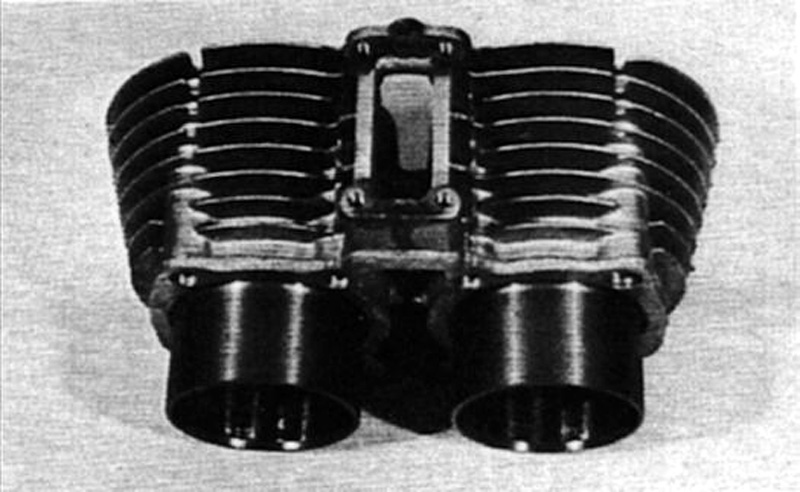
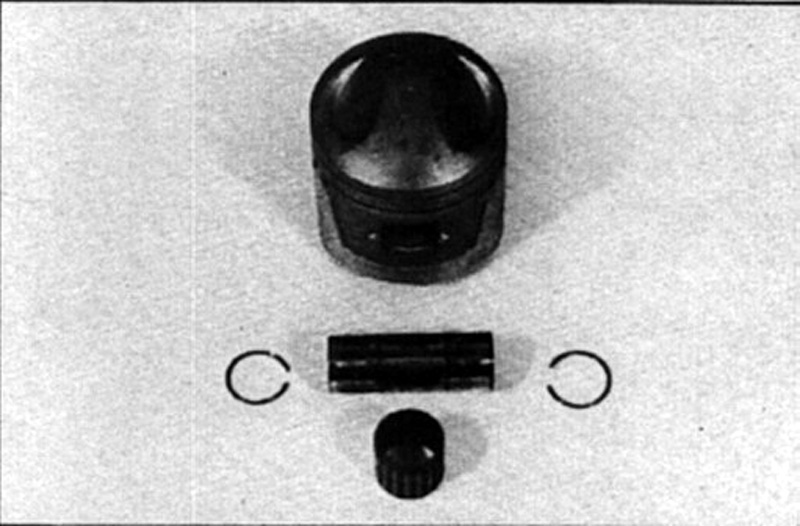
Aluminum
pistons, slightly domed with valve pockets, are of three-ring design, with two
compression rings and one oil control ring. The
alloy cylinder barrel has iron liners. Ribs
are cast between the fins to reduce the mechanical noise level. Noise
suppression is also provided in the aluminum cylinder head by small white rubber
discs placed alternately between the fins. These
measures work quite effectively, counteracting the inherent sound transmitting
nature of aluminum.
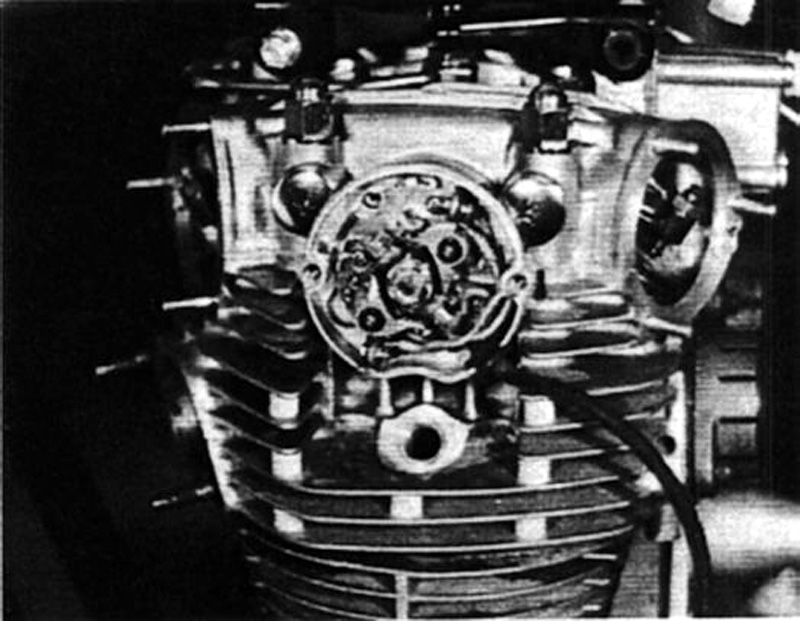 A
spring loaded guide, attached to the wall of a cavity in the cylinder block,
locates the cam drive chain, and takes up unnecessary slack. Chain
tension is regulated by an external adjuster found at the rear of the cylinder. Full-length
studs, originating in the top crankcase half, connect the entire head and
cylinder assembly rigidly to the crankcases.
A
spring loaded guide, attached to the wall of a cavity in the cylinder block,
locates the cam drive chain, and takes up unnecessary slack. Chain
tension is regulated by an external adjuster found at the rear of the cylinder. Full-length
studs, originating in the top crankcase half, connect the entire head and
cylinder assembly rigidly to the crankcases.
Oil pressure is provided by a gear pump driven by a steel spur gear off the crankshaft. The pump is in the primary drive cavity, on the right side of the engine. A double filtering process is incorporated in the lubrication cycle. Oil, passing through a screen at the bottom of the sump, circulates through the pump, and out through yet another screen before it is fed through both ends of the crankshaft to the big ends. Splash and oil mist lubricate the main bearings and wrist pin needles. Oil thrown from the connecting rod big ends is thrown onto the cylinder wall for additional lubrication of the piston skirts. Camshaft and rocker arms are pressure-fed by passageways from an external oil tube at the front of the cylinder. Oil also feeds to the critical scuffing areas of the cam lobes and rockers. After draining down to the sump cavity, the oil begins a new cycle. The overhead camshaft rides on four ball bearings. These bearings are narrow, two of them at each end of the cam doubling up two narrow hearings increases load capacity over a single wide bearing of equivalent size.
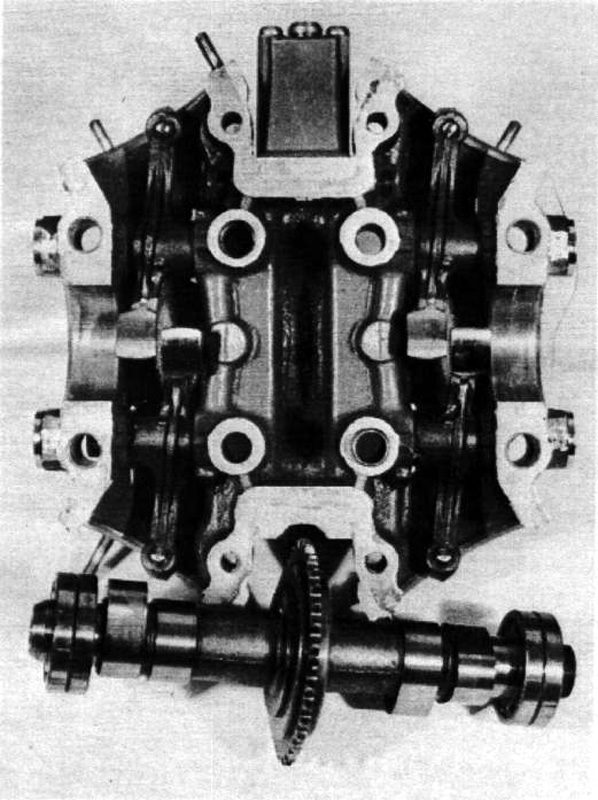
On top of the head is a removable aluminum casting which carries the four individual rocker shafts; it doubles as the top half of the cambox. When this cover is removed, access to the cam and valve train is possible. The four valves are held on seats by a pair of inner and outer coil springs. The spring retainers and keepers are steel. Automotive style umbrella type rubber oil seals slip over the valve stems, and form a barrier around the end of the guide to keep excess oil from seeping down into the intake and exhaust ports.
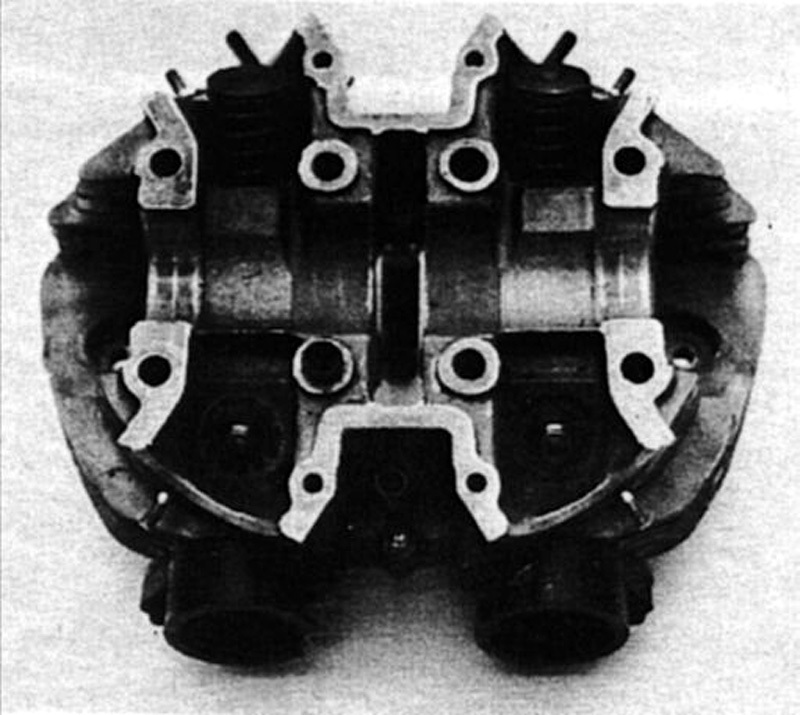 Valve adjustment gear is reached by removing the four
bolt-on triangular shaped covers at the front and rear of the cambox. Adjuster
screws and lock nuts in the rockers regulate the necessary clearance. The
one-piece camshaft is hollow, with the driven sprocket in the middle and lobes
for corresponding valves on either side. Through
the hollow center passes a shaft which connects the contact point actuating cam
on the left with the auto-advance mechanism on the right.
Separate assemblies are found
under oval covers above each spark plug hole.
Valve adjustment gear is reached by removing the four
bolt-on triangular shaped covers at the front and rear of the cambox. Adjuster
screws and lock nuts in the rockers regulate the necessary clearance. The
one-piece camshaft is hollow, with the driven sprocket in the middle and lobes
for corresponding valves on either side. Through
the hollow center passes a shaft which connects the contact point actuating cam
on the left with the auto-advance mechanism on the right.
Separate assemblies are found
under oval covers above each spark plug hole.
Power is transmitted from the crankshaft by a straight-cut primary drive gear that engages directly with corresponding teeth on the clutch gear. This clutch gear is connected to the clutch housing by anti-shock springs. Needle bearings take up the clutch hub end thrust, and the multi-disc clutch transmits power smoothly and easily.
Constant-mesh rive speed transmission gears run in a common cavity with the crankshaft. The engine oil in the sump is churned up onto the gear train and lubricates the entire assembly and the ball bearings that support them. The primary drive gears are also lubricated by this method. With one source of lubrication taking care of everything, routine maintenance is simplified. An oil change every 500 miles or 30 days is a wise move in light of the fact that one oil is the only lubricant for all the critical wear areas in the engine.
The rubber-mounted dual carburetors are of the constant velocity type, and throttle response is excellent. A butterfly valve in the carburetor is actuated by the throttle cables. As this valve is opened by the twist grip, engine vacuum decreases and a diaphragm in the carburetor controls the opening of a second valve to allow passage of the fuel-air mixture in direct relation to the needs of the engine. Efficiency and economy are primary features, as fuel consumption is determined by vacuum, not the indiscriminate yank of the throttle cable by the rider. Air filtration is taken care of by two replaceable paper elements, which are easily reached by removal of the metal side covers.
The
frame is a double loop,
with a single top tube under the gas tank. The
engine unit is snugly cradled between the mild steel tubing, and ample gusseting
is placed at areas of stress around the fork head arid the swinging arm pivot
area. A stout tubular swinging arm contributes to the absence of undue flex and
twist.
 Vibration
is minimal above an idle, suggesting that the frame is "well-tuned" to
the engine. Stability on the road is
evident at all speeds. Steering is
precise, with a slight amount of under steer in the turns. The
fork angle is suitable for a good road hike, and surface irregularities are
overcome with only the slightest amount of handlebar wiggle.
Vibration
is minimal above an idle, suggesting that the frame is "well-tuned" to
the engine. Stability on the road is
evident at all speeds. Steering is
precise, with a slight amount of under steer in the turns. The
fork angle is suitable for a good road hike, and surface irregularities are
overcome with only the slightest amount of handlebar wiggle.
Fork damping and spring rates are matched to the weight and type of road surfaces for which the machine is intended to be used. Yamaha is not trying to kid its prospective owners by calling the XS-650 a street-scrambler.
Appearance
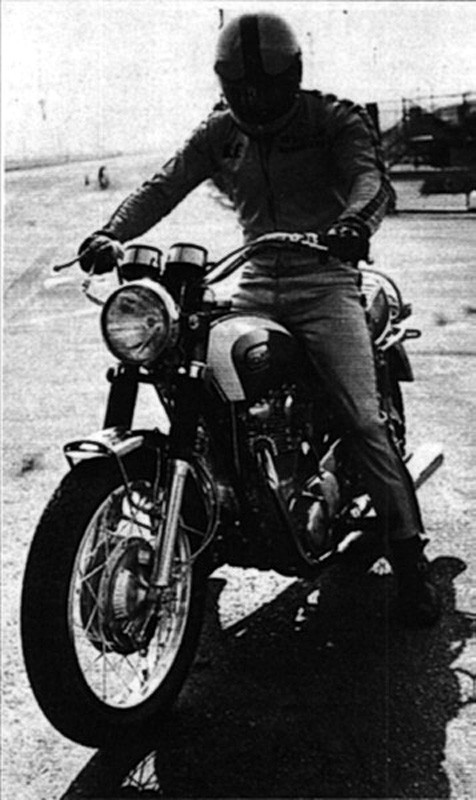
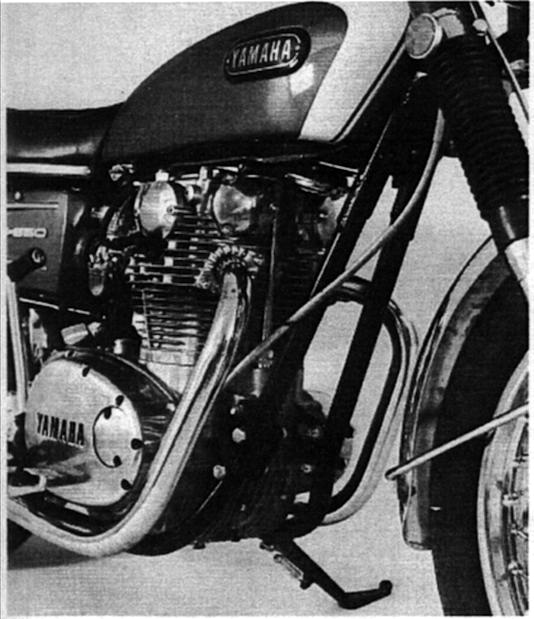
of the new Twin is excellent, with finish of the different components above
average. Chrome steel fenders set
off the black frame, while the candy paint gas tank is in keeping with the
current trend towards attention-getting eye appeal. Individual
tach and speedo heads, as well as the foot rests arid handlebars, are rubber
mounted. This eliminates the
vibration tingle in the hands and feet that are so annoying after a few hours of
riding. Control and seating position
is just right, further assuring a comfortable ride.
One or two prods of the kick starter would bring the throaty Twin to life. Choking is necessary when the engine is cold and a two to three minute warm-up is required to allow the carburetors to respond correctly, another distinctly Japanese trait. The sound from the twin megaphone-styled mufflers is on the loud side, which will cause the public to notice the new machine quite readily. Unfortunately, the gendarmerie as well as our cranky senior citizens will be aware of its rumbling presence, and a trip to see the local judge might result, although Yamaha states they are fully approved.
 The
XS-650 felt quite at home on the winding roads of the
The
XS-650 felt quite at home on the winding roads of the
In its introductory year, the XS-650 must be considered a succes fou (crazy success), having supplied all the ingredients required to please the big Twin fancier in an up-to-date, beautifully styled package. It looks good, rides good, stays clean and shows few of the faults one would expect in a first-year model.
As delivered, it performs on a par with its peers. The
bonus: that new engine is a racing
machine in disguise. For that
reason, we fully expect that Yamaha's partial invasion of American "Class
C" racing-limited previously to its rapid 250 and 350-cc road racers (and
the 250 trackers)-will become complete in very short order.