YAMAHA
XS650B
Line
Leadership At Yamaha Belongs To The 650 . . . A Tall Order For A Vertical Twin
Original
article appeared in Cycle World magazine December, 1974 issue
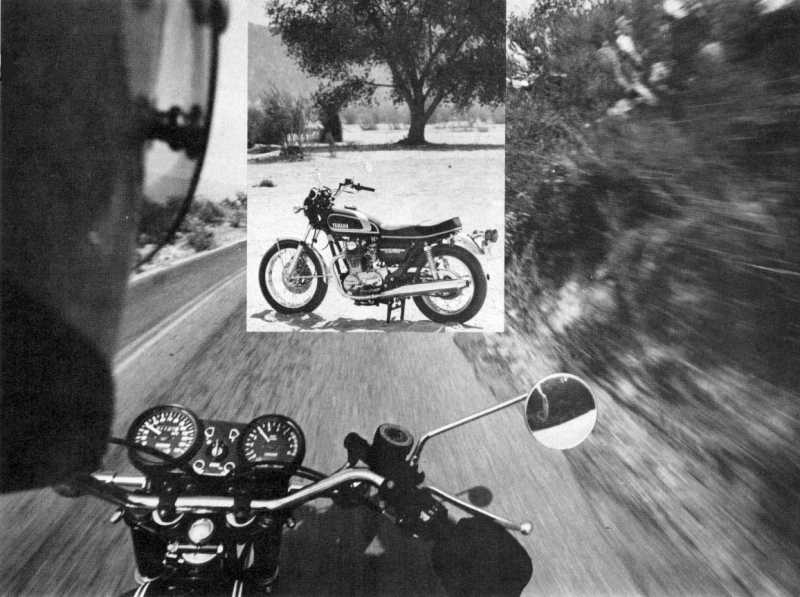 When
other manufacturers are dazzling the motorcycle world with innovative new
models and displays of R&D genius in their
top-of-the-line equipment, Yamaha seems content to rest on its laurels...or
at least on the steadfast solidarity and age-old appeal of the 650 Vertical
Twin. Displacing the never-weaned
750 Twin from the head of the Yamaha pack, the OHC 650 goes up against stiff
competition with practical, but non-earthshaking credentials.
When
other manufacturers are dazzling the motorcycle world with innovative new
models and displays of R&D genius in their
top-of-the-line equipment, Yamaha seems content to rest on its laurels...or
at least on the steadfast solidarity and age-old appeal of the 650 Vertical
Twin. Displacing the never-weaned
750 Twin from the head of the Yamaha pack, the OHC 650 goes up against stiff
competition with practical, but non-earthshaking credentials.
It’s the traditional British concept in a far more
refined and civilized, yet still incomplete package, despite six years of
fussing. That’s what we said...six years.
Seems almost like yesterday that the 1970 green and white, XS1 was
introduced; the bike with the right idea but a long way to go.
And it’s gone a long way; on to the XS1B, the XS2, the TX650 and
TX650A...to now, the XS650B. But there’s been a whole lot more going down than
mere alphabet changes. One ride gives more than subtle indication that the XS650B is
a vastly improved and different motorcycle than the original XS1.
But even the original was lauded as the Twin to end
traditional British woes. No
more oil leaks they said. No more
electrical problems they promised. Quieter was the word.
“Numbing vibrations cut drastically,” read the bold type.
And even the promise of push-button starting.
Hark! A Beezer-Trump minus the acne.
But it was not to be.
Though
the XSl followed through and delivered many of those expected promises, it
lacked an all-important ingredient, the type you cannot put your finger on.
Distress came to many when they found that the XS1 felt Japanese.
So what’s wrong with a Japanese motorcycle feeling Japanese?
Everything...when it’s supposed to feel British.
After
years of Triumph and BSA Twins, riders were ingrained with the idea that
the Britains had themselves a couple of motorcycles that handled beautifully.
That they did. For many
riders that feature alone (coupled with good engine performance), outweighed the
hassles then inherent in a British piece of equipment.
Conversely, all the goodies and conveniences found on Yamaha’s new 650 did
not outweigh the fact that it steered like a wheelbarrow and could be
downright treacherous in certain situations. So in the period of time from then
to now, Yamaha has gone to work on its 650 to correct the imperfections, while
the British have teetered on the edge of doom, beset with labor problems. Yamaha
has succeeded in clearing up many of its; the British are still struggling.
The
XS2B (TX650) of 1973 is virtually a carbon copy of last year’s TX650A…with
some new paint. Significant changes
had taken place in the ‘73/‘74 models and Yamaha was apparently satisfied
with the results, hence the lack of giant upheavals in the present model.
Smoothness
is now a touted feature of many machines in the industry.
Yamaha felt the trait important enough to warrant complex contra rotating
weights and balancers in their 500 and 750 Twins.
The 500 has been successful, the 750 not.
And in the meantime, Yamaha was bugged with a 650 that shook...more than
noticeably. So with all this
emphasis on smoothness and consumer awareness (from reading motorcycle
magazines), they went to work on the problem in the simplest terms possible.
This meant curing what they had, thus not entailing a major redesign or
engineering blast.
Compression
ratios were lowered, then raised. Nothing
too significant happened. Pistons were then lightened 20 percent to reduce the
reciprocating mass inside the engine. Add to this lighter connecting rods, and things start falling
into place. The 650 was smoother.
Most
motorcycle enthusiasts realize that this 650 vertical Twin is much more than
just another engine to Yamaha. It
was and is their legal connection to AMA professional dirt track racing, their
basis for the power unit in the machines run by National Champ Ken Roberts, who
twice has given Yamaha that Number One plate.
And that single digit number is worth much in terms of sales, not just of
650s but of everything in the Yamaha line-up. Number One means exposure and plenty of free advertising.
And this is the motor that got them there, though the differences in
Roberts’ engine and the unit in a standard XS2B are equatable to those between
an armadillo and a tiger.
Like
a British Twin, the engine is compact, simple and straight forward.
Unlike older Triumphs and BSAs, oil leaks are minimal, but the latest
Triumphs are much better in that respect as well, so that advantage is of lesser
significance. There are no pushrods
to operate the valves, rather a simpler and more efficient single overhead
camshaft. The cam gets its drive
from a single-row chain running from the center of the crankshaft.
Chain tension is maintained by an idler gear located behind the cylinder.
Professional
racers switching from Triumphs to Yamahas often have problems getting used to
the Yamaha’s quick to rev-and-unrev type of power delivery.
Gene Romero, factory team rider, relates the feeling back to 1965 and his
Triumphs. “You gotta keep ‘em
revving off the corners or they’ll bog just like the old 500s.
This is due to the small size of the Yamaha flywheels, and this quick
revving ability is immediately apparent in the stock machine as well as the
racing equipment, Sitting at standstill and blipping the throttle gets an
immediate reaction from the engine. And
the lack of flywheel effect lets the rider know in an instant if he has selected
too high a gear in a particular situation.
The 650 will buck and stumble until the rider gets wise.
 Common
practice on many bikes is a pressed-together crankshaft assembly, and the 650
Yamaha follows suit. Four
full-circle crank wheels are employed and the center shaft and wheels are
splined to prevent the movement or variance of these parts. Three roller bearings and a ball bearing support the crank
assembly. Few problems have ever
beset this area so we know they’re robust enough.
The lighter connecting rods turn on needle bearings.
A 360-degree crank configuration means that the pistons travel up and
down together; the rump, rump, rump of the exhaust gives that away in an
instant.
Common
practice on many bikes is a pressed-together crankshaft assembly, and the 650
Yamaha follows suit. Four
full-circle crank wheels are employed and the center shaft and wheels are
splined to prevent the movement or variance of these parts. Three roller bearings and a ball bearing support the crank
assembly. Few problems have ever
beset this area so we know they’re robust enough.
The lighter connecting rods turn on needle bearings.
A 360-degree crank configuration means that the pistons travel up and
down together; the rump, rump, rump of the exhaust gives that away in an
instant.
Straight
cut gears hook up the crank and mainshaft of the five-speed transmission.
Straight-cut gears are noisy but efficient, neither of which is apparent
to the rider of the 650.
A
medium to hard tug on the clutch handle operates the five metal and six
cork-lined friction plates of the wet clutch assembly.
Six springs provide the tension to hold the plates in position.
The clutch hub bushing is lubricated by pressurized oil from the
main shaft.
Shifting
our particular test machine was a bit peculiar. It seemed as though the rider had to force the gears into
position; not that it caused missed shifts or problems such as that...it was
just disconcerting to put so much pressure on the gear-change lever.
Lever travel, by the way, is short.
Coupled with the boot pressure necessary for clean shifts, it made the
gearbox feel vague. At times
neutral was evasive as well. Much
of the time we resorted to finding the “N” quadrant when rolling to a stop.
Far easier that way. Ratios
are well matched to the engine and allow good acceleration as well as sufficient
top speed.
The
recommended 20/50-wt. engine oil is delivered by a trochoidal pump (rotary type)
to the main bearings, crank pins, transmission main shaft, clutch bushing,
shifter fork guide bar and rocker arms. The remainder of the engine parts are lubricated by “oil
splash.” A convenient dipstick
lets the rider keep tabs on oil level.
Conventional
and usually reliable battery ignition is used on the 650.
Two sets of points, located on the upper left of the cylinder head,
trigger the secondary coils at the prescribed time and furnish spark for the
plugs. The points are fitted
directly to the camshaft. An
advance mechanism is used to retard the timing for easy starting and smooth
idle. Yamaha dropped the previously
used compression release from the 650 when they discovered that it wasn’t
necessary to allow the hefty starter motor to spin the engine over.
Works just fine, without it, thanks.
Part
of the reason for a smoother running Yamaha 650 is the carburetion.
The twin 38mm Mikunis are of the constant velocity type, similar to those
fitted on the 500 Twin. Uneven
transitions in carb operation have been eliminated by changes in metering and
circuitry.
Constant
velocity carburetion is interesting. The
velocity of the fuel mixture through the venturi, regulated by the opening of
the butterfly and engine speed, causes a pressure difference between the top and
bottom of the carb piston. The
pressure difference raises and lowers the piston.
If the throttle were snapped closed, the piston would have a tendency to
float in the bore of the carb until the pressure was stabilized.
The diaphragm tends to dampen this movement and eliminates the
accompanying surge. Performance and
operating economy gain as a result. We
averaged 47 mpg in many different types of riding, none of which included
“babying” the motorcycle. With
the four-gal. fuel tank, effective range with reserve approaches 200 miles.
Generally our XS went on reserve at about 160 to 165 miles on the
resettable odometer. Roughly seven-tenths of a gallon would remain at this
point.
Like
we have said, the latest 650 Yamaha is decidedly smoother than its predecessors.
The numbing vibration of the past is gone.
But the bike is still not comfortable enough for longer trips.
Even though the handlebars are rubber-mounted, their shape sits the rider
straight up on the seat and in the force of the wind.
A slightly lower and more forward position would lean the rider into the
wind and into a far more comfortable proposition.
Grips are far too hard, and all but eliminate the advantage of the
rubber-mounted bars. And the
seat...typically Japanese, is good for about 100 miles of highway before the
rider starts looking for a massage parlor to get the circulation going again in
his butt.
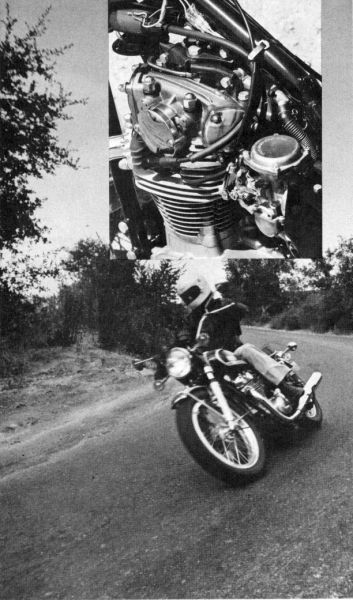 The
current 650 is blessed with the same frame geometry as past versions but heavier
gusseting, stronger tubing and a longer swinging arm add much to handling.
Yokohama tires are new too, and though not nearly the best, they do a far
better job than what came as original equipment before.
Most of the new gusseting is concentrated at the steering head and in the
swinging arm pivot locations. Reduced
flex in all areas is readily apparent. Safer,
better...yes, but still not a Triumph or a bike that one will want to throw
around casually on twisty roads. It
does not have the tires or the ground clearance or the heritage of the RD350.
And the suspension lacks heavily in many important respects.
The
current 650 is blessed with the same frame geometry as past versions but heavier
gusseting, stronger tubing and a longer swinging arm add much to handling.
Yokohama tires are new too, and though not nearly the best, they do a far
better job than what came as original equipment before.
Most of the new gusseting is concentrated at the steering head and in the
swinging arm pivot locations. Reduced
flex in all areas is readily apparent. Safer,
better...yes, but still not a Triumph or a bike that one will want to throw
around casually on twisty roads. It
does not have the tires or the ground clearance or the heritage of the RD350.
And the suspension lacks heavily in many important respects.
Rough
surfaces bounce the machine around to the point of grip-tightening concern,
especially when leaned over in a bend. Front
forks remain oblivious to many surface irregularities; the ones that get their
attention usually get the rider’s too as he steers around them.
The rear shocks feel at times as
though
they were made
from bar stock; they’re
that
indifferent to the bumps. So
the 650’s suspension is the
next
area Yamaha’s engineers should turn their attention
to. As it stands, accessory shocks
are in order for any type of riding and the forks will have to be diddled with.
If not, a kidney belt is in order.
Much
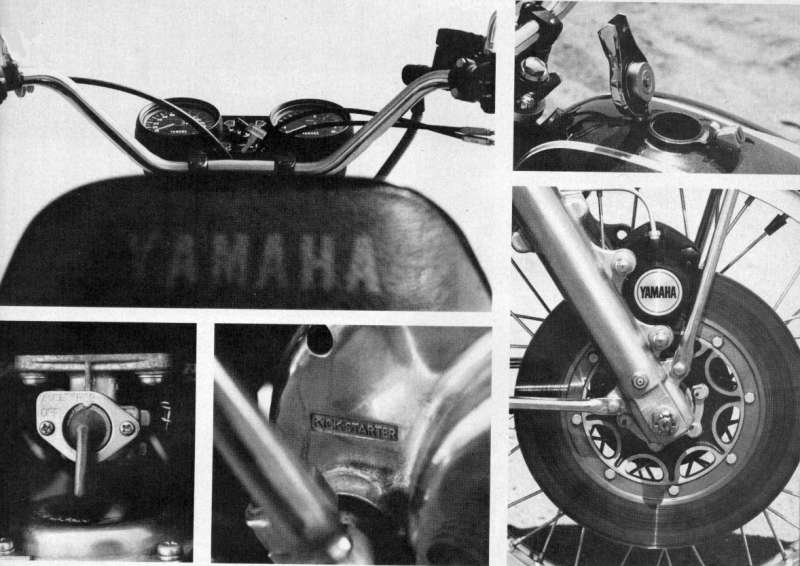
of the remainder of the machine is typically Yamaha; finish is good but
overdone, brakes work better than “good,” even though the tires can’t keep
up, warning lights do lots warning. A
good deal of Yamaha tradition remains.
But
it’s what doesn’t
remain that’s important. Yamaha’s 650 is a better motorcycle.
In this day and age of Threes, Fours, Sixes, even Rotarys, what can be
said for the likes of a 650 vertical Twin? Plenty. And we’re glad it’s
here....